- Home
- Succulents
- Huernia
- Huernia zebrina
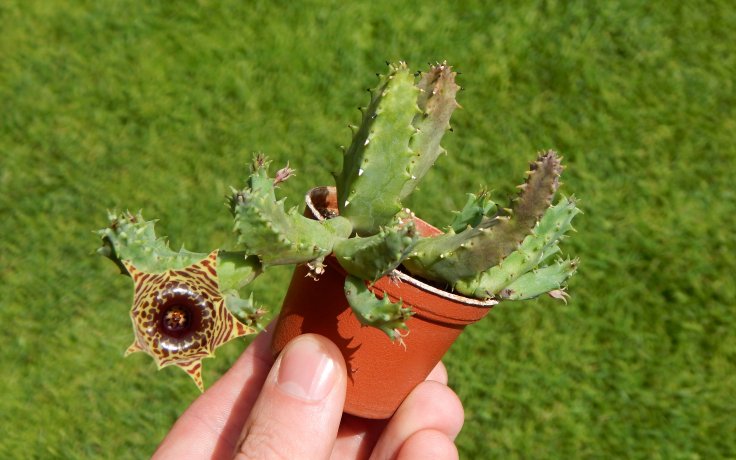
Huernia zebrina
The plant likes partial shade and sunny locations.
Always water a few days after the substrate has dried out. Reduce watering in winter. Overall, water less frequently.
It can withstand temperatures down to -1.1 °C for short periods. However, the plant is not frost-resistant.
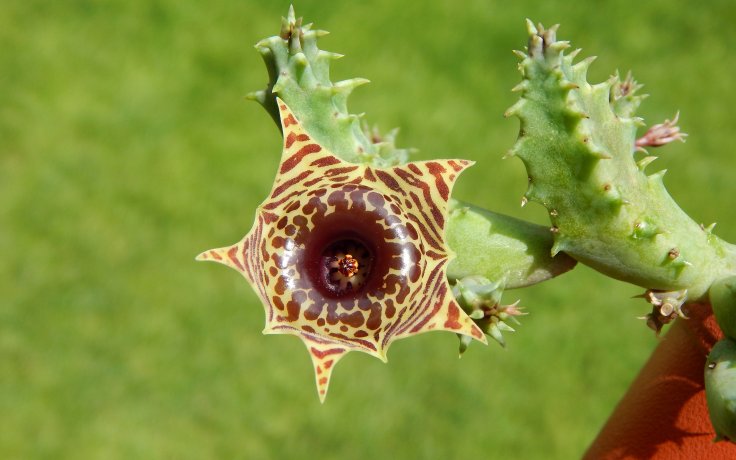
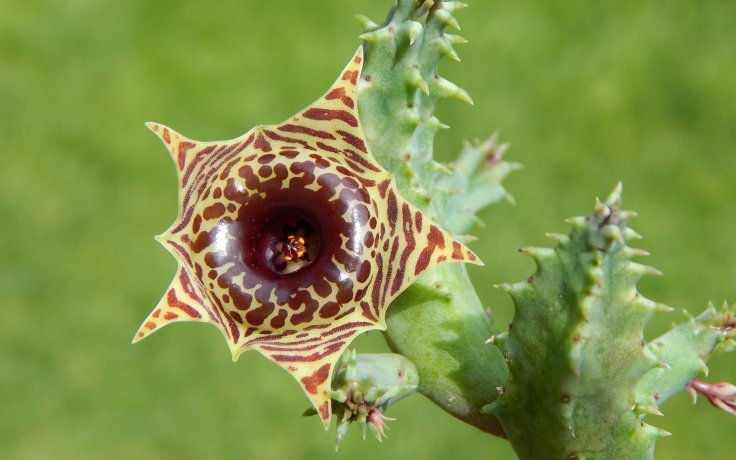
The flowers can grow up to 5 cm in diameter and gradually open one after the other.
Huernia zebrina originates from southern Africa, occurring in Mozambique, Zimbabwe, Namibia, South Africa, and Eswatini. The epithet zebrina means “zebra-striped” and refers to its strikingly banded flowers. The plant is also known by the common name Little Owl Eyes, and it has received the prestigious Award of Garden Merit from the UK’s Royal Horticultural Society. In nature it grows in open dry scrub and rocky areas, often on limestone or hard clay soils.
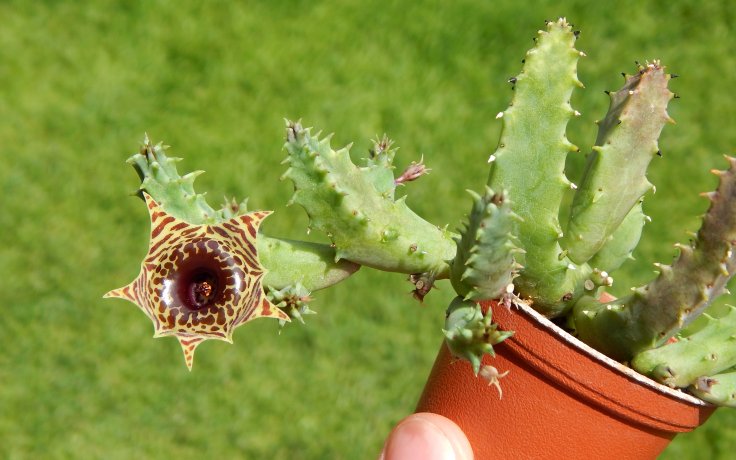
The stems are grey-green, often mottled with purple. They are fleshy, irregularly branched, and can reach up to about 12 cm in length and around 2 cm in thickness. The plant has upright to trailing shoots with tubercles arranged into 4 to 6 angles, and over time it can form a clump up to about 50 cm in diameter.
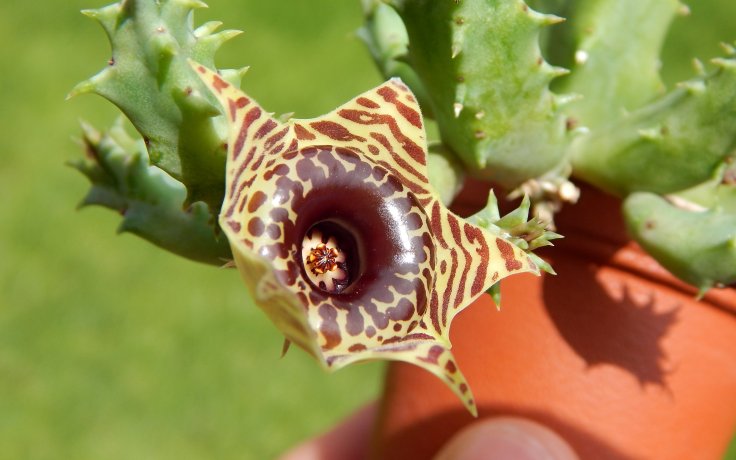
Flowers appear from late spring to early autumn on short stalks and develop gradually. They are star-shaped, reaching up to about 5 cm across, with a creamy to greenish-yellow background marked by irregular red to chestnut transverse stripes. The inner part of the flower is usually uniformly dark red to chestnut, creating a very strong contrast.
Huernia zebrina grows best in a bright position with some light shade, as very intense sun may cause pigmentation or even scorching of the stems. Too little light leads to weak growth and reduced flowering. In winter the plant should be kept rather dry and grown in a warmer environment, as it does not tolerate cold well. Fertilising is usually not necessary. If you are looking for a Huernia with some of the most striking striped flowers, Huernia zebrina is one of the most popular species.