- Home
- Succulents
- Faucaria
- Faucaria tigrina Grahamston

Faucaria tigrina Grahamston
The plant likes a sunny habitat, but can tolerate partial shade.
Always water a few days after the substrate has dried out. In the winter, stop watering after a few days.
It can tolerate -6,7 °C in the short term. However, the plant is not hardy.
The species was discovered as early as 1790.
Faucaria tigrina Grahamston is a species known under the names Tiger’s Jaw or Shark’s Jaws. This South African succulent was described as early as 1790 and is a narrowly restricted endemic of the area around the town of Grahamstown in the Eastern Cape. Its range is smaller than 200 km², and today only a few localities are known, as part of the populations have declined due to urban expansion. It grows at elevations of approximately 550–920 m, and its mottled coloration, resembling lichens and reddish rocks, is likely related to mimicry in its natural habitat.
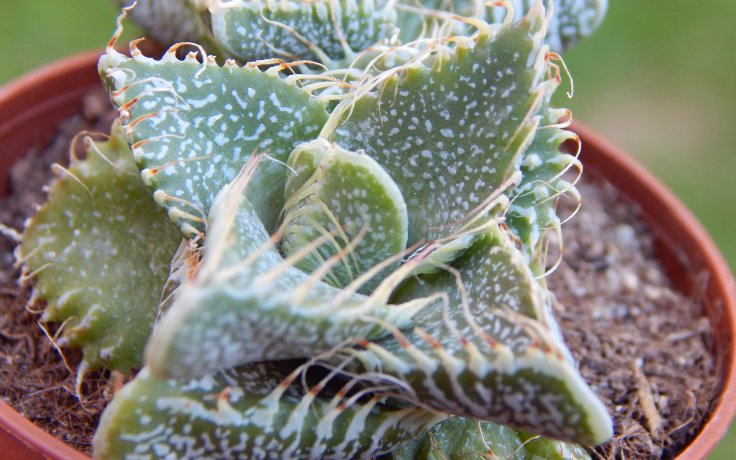
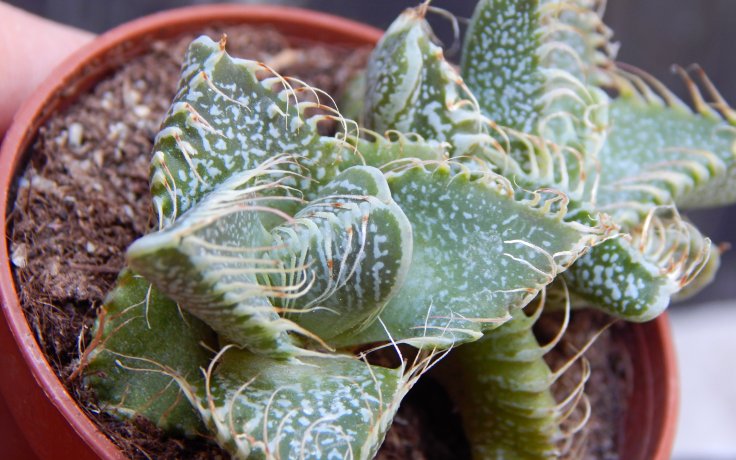
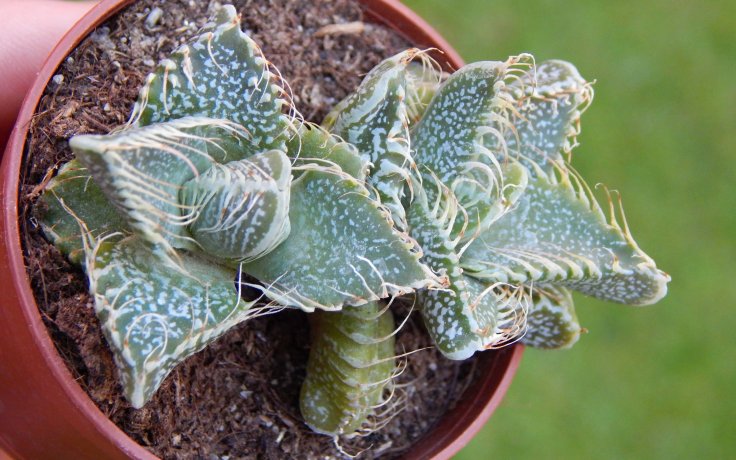
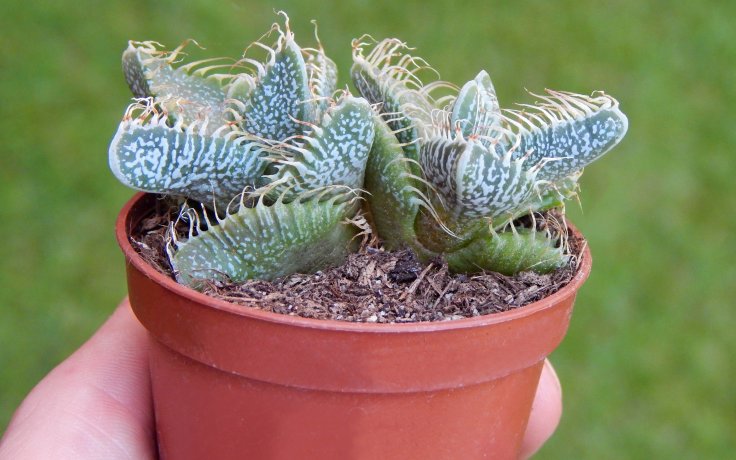
This succulent has green to grey-green leaves that may shift into bluish-purple tones. The leaves are triangular, short, and very tightly packed, with a shape reminiscent of open jaws. The surface is strongly mottled, and the margins usually bear 9–10 teeth with long bristles. The plant is mostly stemless, though very short stems may occasionally occur, and it forms small, compact clumps.
The flowers are striking, deep yellow, and can reach up to 5 cm in diameter. They are composed of a large number of narrow petals, sometimes up to around 120. Flowering may occur at different times of the year, but under our conditions it is most often observed in autumn.
Faucaria tigrina Grahamston is an undemanding succulent that requires rather restrained watering. Watering should be significantly reduced in both summer and winter, and the plant should not be fertilized. Thanks to its compact growth and showy flowers, it represents an interesting species for collections of Faucaria.