- Home
- Succulents
- Euphorbia
- Euphorbia mauritanica
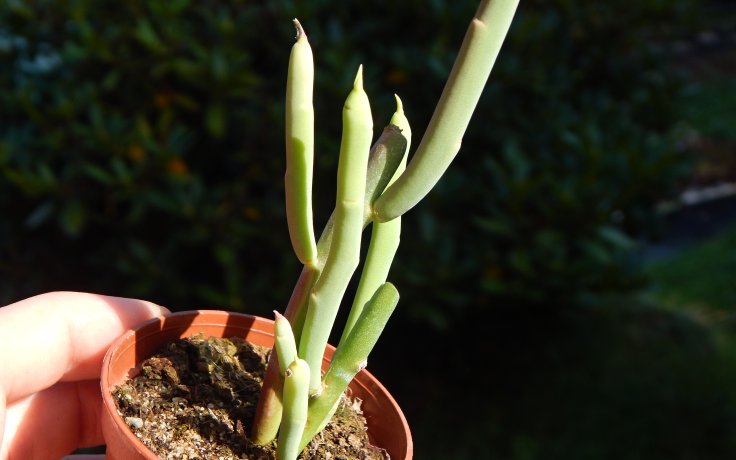
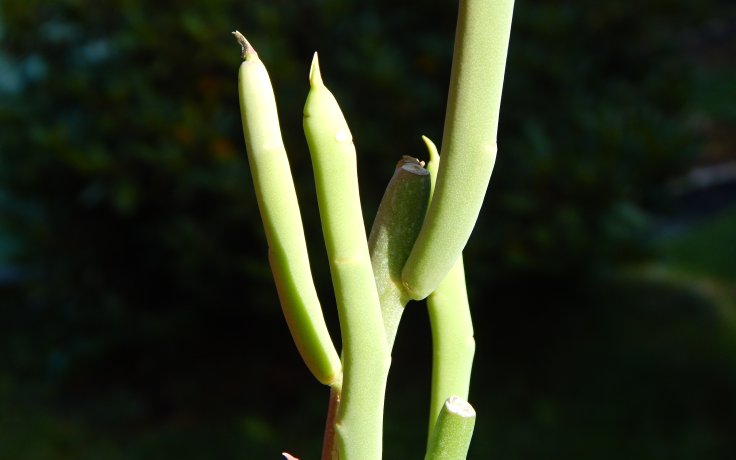
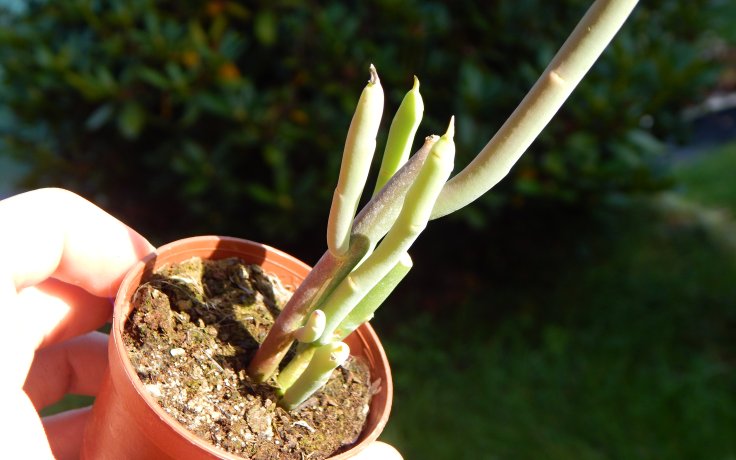
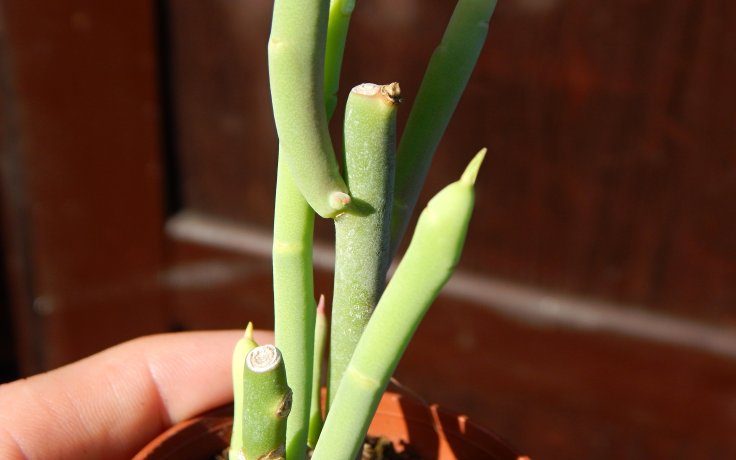
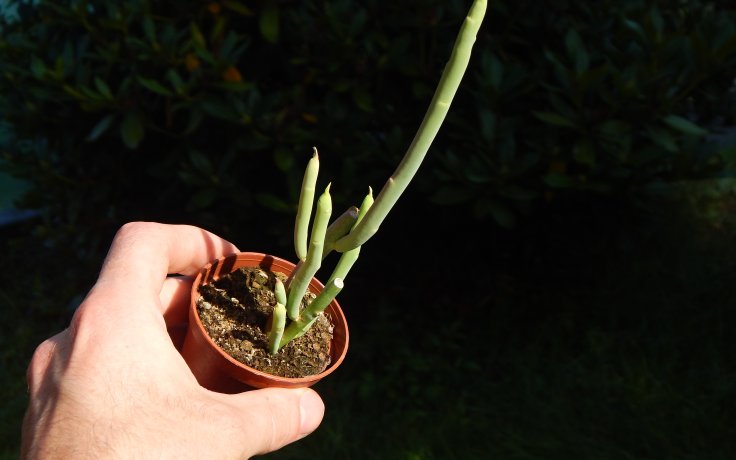
Euphorbia mauritanica
Succulents like sunny and semi-shaded locations.
Always water a few days after the substrate has dried out. Reduce watering in winter.
It can withstand temperatures as low as -3.9 °C for short periods. However, the plant is not frost-resistant.
The epithet mauritanica refers to ancient Mauretania in North Africa, which included present-day northern Morocco and part of Algeria.
Euphorbia mauritanica, also known as Pencil Milkbush, is a species described by Carl Linnaeus in 1753. The specific epithet mauritanica refers to Mauritania, an ancient region of North Africa. It is native to dry areas of Africa, where it is adapted to long periods without rainfall.
The stems are yellow-green to grey-green, cylindrical, and marked with alternating leaf scars. Small leaves appear only at the tips of young stems and are short-lived. The stems arise from a thick root and form a densely branched shrub. In nature, the plant can reach about 90 cm in height and up to 1.8 m in width, while in containers it remains noticeably smaller.
The flowers are bright yellow and appear in clusters at the ends of young branches. Flowering usually occurs from winter to spring and stands out clearly against the green stems.
Euphorbia mauritanica requires a well-draining substrate and a bright position. During winter, it is best kept at room temperature with very limited watering. The plant is toxic and releases a milky sap when damaged, so care should be taken when handling it. With proper care, it is a striking species valued for its unusual stem structure even outside the flowering period.