- Home
- Succulents
- Euphorbia
- Euphorbia globosa
Euphorbia globosa
Succulents like sunny and semi-shaded locations.
Always water a few days after the substrate has dried out. Reduce watering in winter.
It can withstand temperatures as low as -3.9 °C for short periods. However, the plant is not frost-resistant.
In nature, it grows in dry, rocky areas of South Africa, where rainfall is minimal and the soil is predominantly gravelly.
Euphorbia globosa is a succulent native to the eastern part of the Cape region in South Africa. It grows in dry areas with rocky ground and belongs to spineless species of Euphorbia. In habitat it occurs scattered and forms low, compact growths.
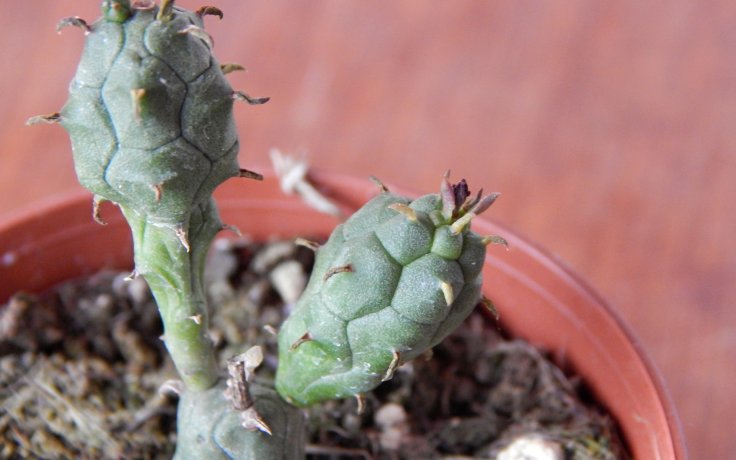
The plant produces spherical to shortly elongated segments in shades of green to grey-green. The individual segments are interconnected and arise from a short, thickened base. Over time, dense and irregular clusters develop, resembling chains of small rounded segments. The stem remains low, and the plant expands mainly sideways.
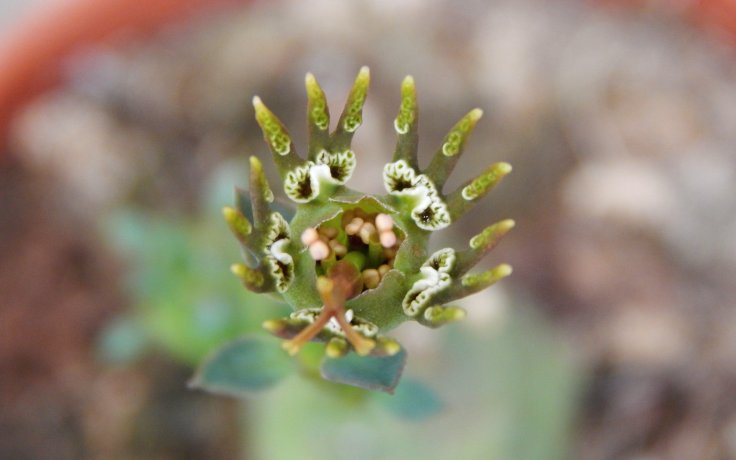
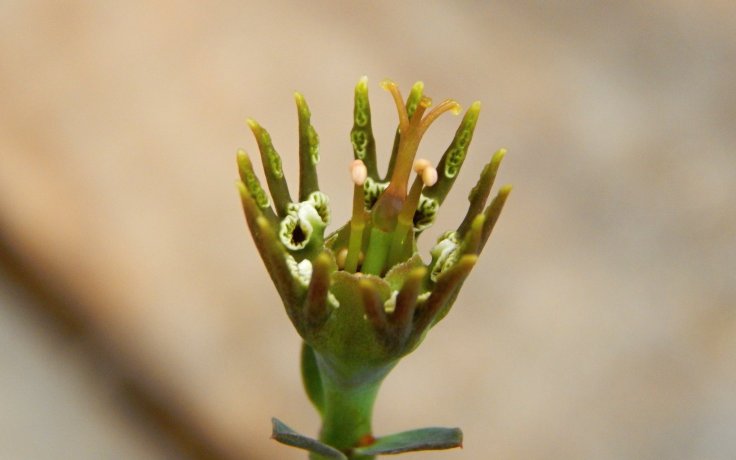
The flowers, known as cyathia and typical for the genus Euphorbia, are small and yellow-green in colour. They appear on thin stalks emerging from the ends of the segments, usually in spring.
A bright position and a very well-draining substrate are recommended for cultivation. Watering should be moderate, allowing the substrate to dry thoroughly between waterings. This succulent grows slowly and tolerates drought better than excess moisture, making it a stable houseplant for long-term cultivation.