- Home
- Succulents
- Crassula
- Crassula Springtime variegata
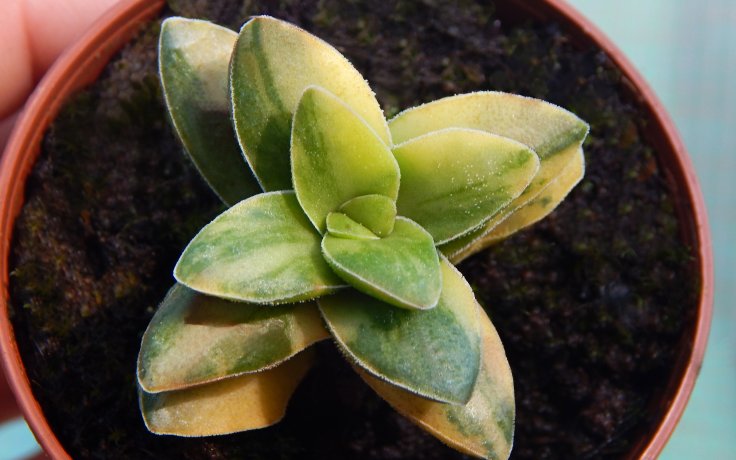
Crassula Springtime variegata
The plant prefers semi-shaded locations.
Water regularly, always a few days after the substrate has dried out.
It can withstand temperatures as low as -3.9 °C for short periods. However, the plant is not frost-resistant.
Variegation in this cultivar tends to be subtle and often creates creamy edges, which are most noticeable on young leaves.
Crassula Springtime variegata is a variegated form of the well-known hybrid Crassula Springtime, which originated from a cross between Crassula perfoliata var. minor and probably Crassula rupestris. This hybrid was bred in 1980 by Hans Britsch, an American breeder specializing in plants of the family Crassulaceae. The name Springtime refers to the spring season and points to the long persistence of flowers into spring, which is typical for this plant even in its variegated form.
The plant has slender stems and fleshy leaves with distinct variegation. The leaves are green combined with light yellow to creamy areas, with finely ciliate margins and small scattered papillae. They are arranged in opposite pairs and clasp the stem closely. The stems initially grow upright but may lean over time under the weight of the leaves. Growth is slow, and the plant usually reaches a height of around 15 cm.
The flowers are star-shaped, lightly scented, pale pink with a red center. They appear in dense clusters at the ends of the stems, usually in late winter and early spring. The flower clusters can reach a diameter of about 5 cm.
Crassula Springtime variegata requires a well-draining substrate, a bright position, and watering only after the soil has dried. The substrate should not remain waterlogged for long periods. Thanks to the variegated leaves, it is suitable for containers and smaller succulent groupings, where the leaf pattern and color contrast stand out.