- Home
- Succulents
- Aloe
- Aloe castilloniae (Itampolo)
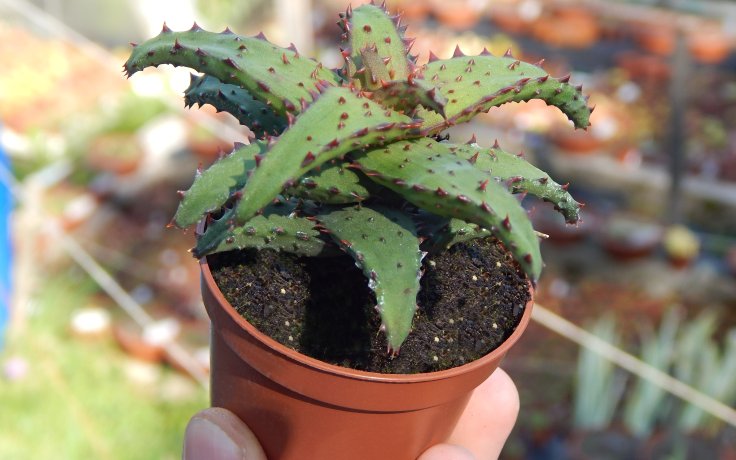
Aloe castilloniae (Itampolo)
Ideally, place in full sun or partial shade.
Always water a few days after the substrate has dried out. Reduce watering in winter.
It can withstand temperatures as low as -3.9 °C for short periods. However, the plant is not frost-resistant.
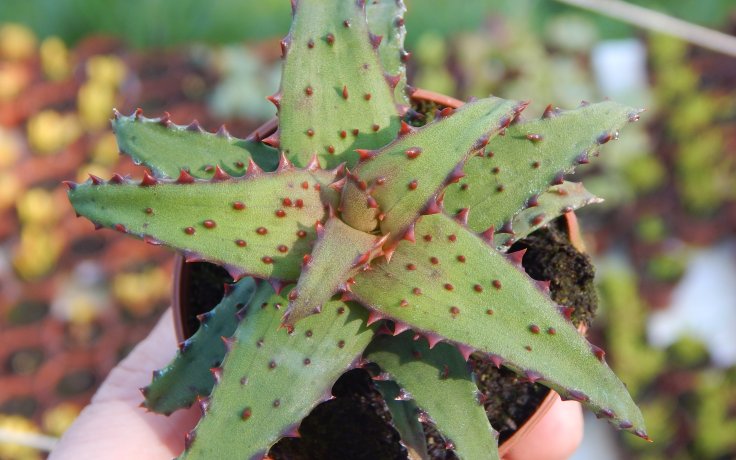
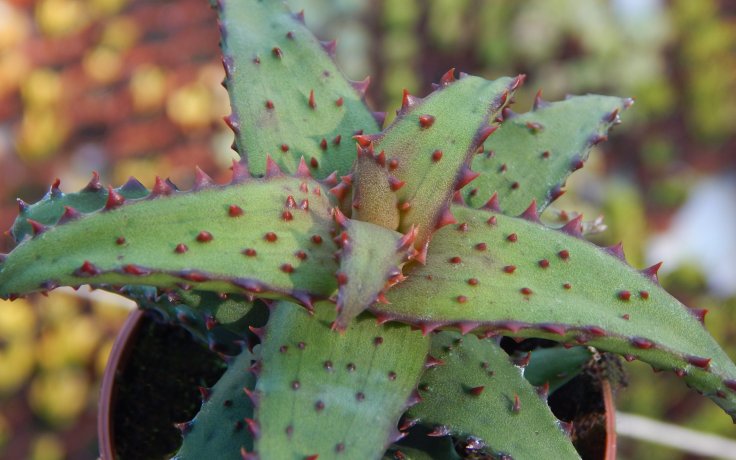
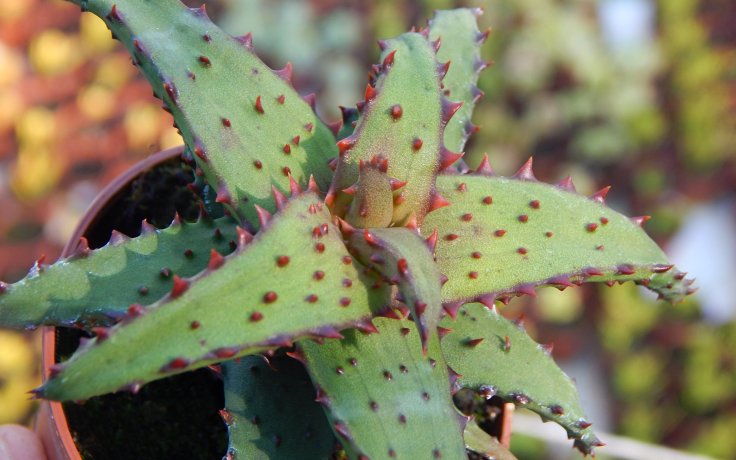
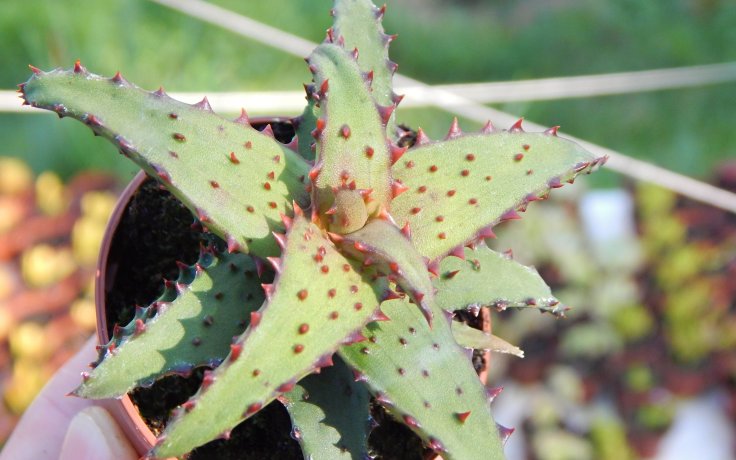
The variability of the bumps is one of the reasons why this species is so popular among collectors.
Aloe castilloniae (Itampolo) is a species of aloe described in 2006. The specific epithet “castilloniae” honors Bernadette Castillon, a horticulturist specializing in Madagascan succulents and the wife of botanist Jean-Bernard Castillon, who formally described this species. It originates from southwestern Madagascar, near the village of Itampolo, where it grows several kilometers inland on porous calcareous sandstone at elevations of approximately 100–250 m.
The plant has leafy stems topped with rosettes of olive-green, curved leaves. The leaf margins bear red teeth, and scattered red tubercles appear on both leaf surfaces. It branches from the base and gradually forms denser clumps with age. Growth is slow, and individual stems can reach lengths of up to about 40 cm.
The flowers are orange and usually appear in autumn and winter. They are borne on flowering stalks that can reach a height of around 5 cm.
Aloe castilloniae requires a well-draining substrate and a bright position. Watering should be occasional, only after the substrate has completely dried, as prolonged moisture is unsuitable for this species. It is a slow-growing aloe with a subtle yet distinctive appearance, appreciated especially by growers interested in less common Madagascan species.